


If you have ever stood on a worksite, warehouse floor, or aggregate yard and watched materials flow nonstop, you have probably seen equipment at work. These machines keep stockpiles organized and operations running, but among the people who run them-a stacker operator, a maintenance tech, or a business owner buying from a stackers supplier-one question comes up repeatedly: How often should I cycle my equipment?
Before answering, we need to define the term. In stockyard operations, "cycling" is often used to describe two very different actions: physical repositioning of the machine (moving the whole unit to a new area) and stacking passes (the sequence of moving the boom or discharge point to build a windrow or lift).
Confusing these two is a common mistake. Let's look at how different equipment types handle this. If you use mobile stackers, you have self-contained units designed for temporary or flexible setups. In contrast, mobile conveyor systems are usually integrated with other processing equipment, like crushers or screeners.
For a smaller operation, you might use a wheel stacker. If you own a wheel stacker, you are likely handling shorter jobs where stockpiles are relatively small. For these applications, physically repositioning the machine too often wastes fuel and wears out the wheel bearings and tires. For a wheel stacker in light-to-moderate use, reposition only when the current footprint reaches its design limits-meaning the material is approaching the maximum designed height or angle of repose for that specific unit, not an arbitrary fixed percentage. With wheel stackers, avoiding unnecessary travel is key.
On the other hand, a high-volume radial telescopic stacker must be managed differently. Modern radial telescopic stackers use automated windrow or incremental lift programs to combat segregation. Instead of physically moving the entire machine every few loads, the discharge point moves along the arc to layer coarse and fine materials together. For a radial telescopic stacker, you should let the automated program complete its passes before repositioning. Pushing a radial telescopic stacker to constantly reposition physically will accelerate structural fatigue and unnecessary wear.
If you are upgrading, you might consider whether a portable radial stacking conveyor fits better than a basic unit. A portable radial stacking conveyor is built for frequent relocation, but the same rule applies: let the geometric limits of the stockpile-not a timer-dictate when you move. In heavy-duty yards, you may use tracked link conveyors for continuous transport. Tracked link conveyors have different ground-bearing characteristics and should be repositioned based on the pad or stockpile footprint limits.
When you need to reach multiple bins or trucks, a telescopic conveyor system provides reach without moving the chassis. You must ensure that the extended sections of a telescopic conveyor system are fully retracted and locked before relocating the main unit. If your operation uses various telescopic conveyor systems for different lines, ensure operators are trained on the specific limits of each unit.
In high-capacity yards, high-volume radial stackers rely on proper sequencing. When running these radial stackers, the focus must be on layering to prevent particle segregation, which directly impacts product quality in bulk material handling.
Material characteristics also dictate your strategy. Fine, dry materials like sand flow easily and can segregate quickly. When handling fine materials, you must ensure your layering passes are managed carefully to prevent dust and segregation. Coarse, heavy materials like gravel create steep, unstable piles, and depositing them in one tight spot puts strain on the boom. For these, you must ensure the discharge point is advanced in a timely manner. Sticky or wet materials like clay or compost require even closer attention, as they can cause build-up on the belt and structural imbalance. In these cases, you may need to adjust your passes more frequently to prevent clumping.

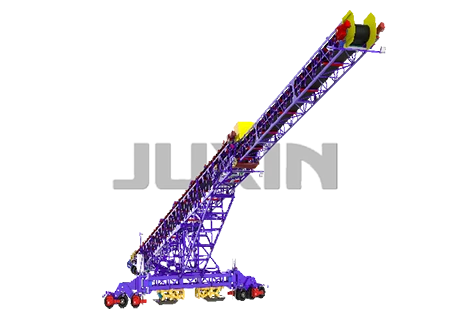
Maintenance and safety must also dictate your schedule. For any equipment, including a portable radial stacking conveyor, idler seizure is a major risk. A seized idler creates friction heating, which is a fire hazard in dry, dusty yards. Maintenance techs must regularly inspect for seized rollers and belt tracking issues. If you are operating a mobile stacker, always deploy the outriggers and ensure the ground bearing capacity is sufficient before operation.
Before performing any maintenance on a mobile stacker-whether clearing a jam or inspecting the belt-always follow Lockout/Tagout (LOTO) procedures. Release stored hydraulic and potential energy; do not rely on the hydraulic system to hold a raised boom. For a mobile stacker, this is non-negotiable.
Monitoring your cycles requires basic telematics. Modern units often have sensors to track wear and operating hours. By tracking data, you can adjust how you operate your unit. If you are running a portable radial stacking conveyor, a simple timer can help establish a baseline. But remember, there is no single number that works for everyone.
If you are in the market for equipment to get this process right, we have options for every operation. Whether you need a portable radial stacking conveyor for small jobs or a radial telescopic stacker for large yards, our equipment is designed to help you optimize your operating strategy. If you want to learn more about how our equipment can work for your specific needs, reach out to our team.
References
- Bulk Material Handling Equipment Manufacturers Association. (2022). Best Practices for Stacker Cycle Optimization in Aggregate Operations. Journal of Material Handling Technology, 45(3), 112–128.
- American Society of Agricultural and Biological Engineers. (2021). Maintenance Guidelines for Mobile Stackers in Agricultural Bulk Material Handling. ASABE Standards, MP 491-21.
- National Bulk Carriers Association. (2023). Stockpile Management: Preventing Segregation and Optimizing Cycle Times. Port Operations Manual, 17(2), 45–62.
- Conveyor Equipment Manufacturers Association. (2022). Hydraulic System Wear in Mobile Stackers: Cycle Frequency Impact. CEMA Technical Bulletin, TB 107-22.


